
You learn your first French word, Bonjour then Merci. And somewhere along the way, you realize that learning French is much bigger than memorizing a list of words. You want to understand what people are saying, form your own sentences, express an opinion, write an email, follow a conversation and eventually speak without mentally translating every sentence.
So how do you know how far you have actually progressed?
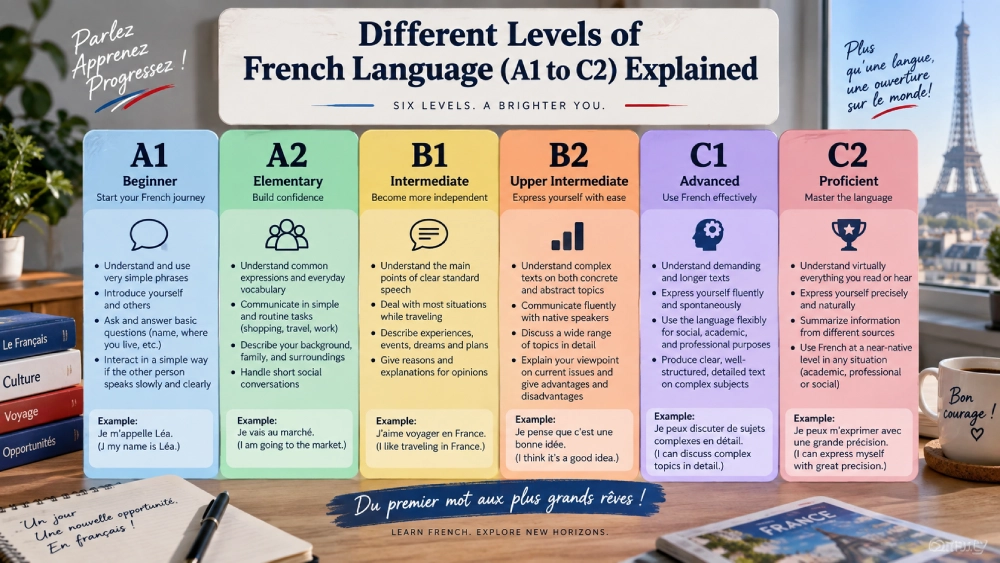
This is where the different levels of French language become important. French proficiency means to use the Common European Framework of Reference for Languages (CEFR), which divides language ability into six levels of A1, A2, B1, B2, C1 and C2. These levels provide a structured way to understand what a learner can do with the language at different stages.
Instead of simply saying, I want to learn French, you must identify that where you are now, where you want to go and what kind of French you actually need if you want to join French language classes in Indore. Let's understand the journey from A1 to C2.
The six CEFR levels are generally divided into three broad stages:
| Level | Stages | What You’ll Learn? |
|---|---|---|
| A1 | Beginner | Basic communication |
| A2 | Elementary | Everyday conversation |
| B1 | Intermediate | Independent communication |
| B2 | Upper-Intermediate | Confident communication |
| C1 | Advanced | Effective professional and academic use |
| C2 | proficiency | Highly advanced command |
The important point is that these aren't simply six grades because each level represents a growing ability to listen, speak, read and write in French. Therefore moving from A1 to A2 isn't just about learning more vocabulary, it is about becoming more independent. When moving from B1 to B2 isn't simply about memorizing additional grammar rules. You're developing the ability to understand and communicate increasingly complex ideas. That is what makes the CEFR progression useful.
A1 is where most complete beginners start. You don't need to know French before entering this level. The focus is on building your foundation and becoming comfortable with the sounds, words and basic structures of the language. At A1, you can learn to:
Imagine you are meeting someone for the first time, and say your name, ask their name, explain that where you live and talk about a few familiar subjects where you may still pause frequently and may make grammatical mistakes while meeting people to speak slowly. That's a completely normal situation.
A1 isn't about sounding fluent, but about becoming comfortable enough to start using French.
Who should take A1? A1 is ideal for:
A2 is where your French starts becoming more practical because you have already learned the fundamentals, so now you begin connecting them into more useful conversations.
At A2, you can increasingly talk about your daily routine, hobbies, work, past experiences and future plans.
Your vocabulary expands and your sentence structures become more flexible. Also, you will begin working more seriously with different tenses and everyday conversational patterns.
At A1, you might say that I live in Indore, and in A2, you can start explaining more about your life, your routine, your preferences and your experiences. You aren't just answering questions. You are beginning to keep a simple conversation going. For the travellers, students and professionals, then A2 can make everyday situations considerably easier.
B1 is where many learners experience a major confidence boos and are no longer restricted to basic conversations. You can start explaining experiences, expressing opinions and discussing familiar topics in greater detail. Here, the learners will work toward being able to describe experiences, explain opinions, handle travel situations, write organized paragraphs and understand the main points of straightforward conversations and texts.
Your French doesn't have to be perfect, but you will still make mistakes. The difference is that you can keep communicating despite them.
For instance, you are travelling in a French speaking country and something unexpected happens. In A1, you might know enough to ask a basic question, but at B1, you have a much better chance of explaining the problem, understanding the response and continuing the conversation.
That independence is one of the defining changes between beginner and intermediate French. For people with long-term academic, professional or international goals, B1 is therefore an important milestone.
B2 takes French to another level where you are expected to understand more complex language and communicate with significantly greater independence. Here, the learners can work toward:
B2 is particularly useful for learners interested in:
C1 is no longer about simply being able to communicate. It is about communicating effectively, precisely and flexibly.
The C1 learners can handle longer and more complex texts, understand implied meaning more easily and express ideas with considerably greater precision.
Here, you may be expected to understand complex articles, follow extended discussions, give structured presentations, write formal documents, explain complicated ideas, adapt your language to different situations and communicate comfortably in academic or professional environments
The difference between B2 and C1 can be subtle at first; however it becomes increasingly visible in sophisticated conversations and writing.
While at B2 you may be able to participate confidently in a discussion, in C1, you can increasingly control how you to improve your vocabulary, tone, structure and level of precision.
C2 represents the highest level in the CEFR framework. This is where the learner develops an extremely advanced command of French.
A C2-level learner can work toward understanding virtually everything they hear or read, synthesizing information from different sources and expressing themselves with a high degree of precision and spontaneity. This doesn't mean that you suddenly become French.
It means that your ability to operate in the language is exceptionally advanced. C2 is for people who perform academic or professional activities demand sophisticated French, including specialized communication, advanced research, high-level translation or linguistic work. The DALF certification pathway covers C1 and C2.
This is one of the most important questions to answer before joining a course. You don't necessarily need C1 or C2. Your target should depend on your purpose.
If you are Learning French as a Beginner then start with A1, and don't rush.
Have a strong foundation to make A2 considerably easier.
While A1 and A2 can provide a useful foundation for basic everyday interactions, but for greater independence and more comfortable conversations, making progress towards B1 makes sense.
Knowing the levels is useful, but knowing how to move between them is even more important.
A good French course should not treat A1, A2, B1 and B2 as isolated grammar classes.
KThe skills should build on each other.
This is why learners should ask an institute about its complete progression pathway before enrolling. The different levels of French language provide something extremely valuable to learners, which is a roadmap.
Instead of vaguely saying, I want to become fluent, you can set measurable milestones at all levels because learning French isn't about reaching an arbitrary finish line. It is about moving step by step until the language that once felt unfamiliar becomes something you can actually use.
Address :10,Shivampuri Colony ,Near Bholaram Ustaad Marg, Indore,Madhya Pradesh 450331,India